Kali ini aku ingin menulis sedikit tentang tempat dimana aku dibesarkan.Nama tempat ini dikenali sebagai PUB Sekudai.Singakatan nama dari cabangan logi air Singapura dimana perjajian Air Singapura pada 1961 dengan kerajaan Malaysia.Jadi terdapat berberapa buah logi air Singapura seperti di Gunung Pulai,Tebrau,Kota Tinggi dan juga Sekudai.
Kalau nak di "recall" balik ingatan ku.Aku tiba di pintu gerabang PUB sekudai dengan dijaga megahnya oleh Askar Malaysia (Ini memang termakbub didalam perjanjian Air Malaysia - Singapura).Aku membonceng motorsikal bapaku pada sekitar tahun 1974.Dalam keadaan sedikit ketakutan dan "excited" aku membonceng dengan menikmati pemandangan yang tak pernah ku lihat dalam hidupku sebelum ini.Suasana bersih dengan bangunan-bangunan putih yang berbagai bentuk dan rupa.Pokok-pokok bunga tertanam dengan rapi dan cantik.Kedengaran suara-suara kanak-kanak bermain yang semuanya agak sebaya denganku tetapi agak ganjil bagiku ketika itu.
Welcome
Monday, September 05, 2011
Tribute to Raja Ravi Varma
Raja Ravi Varma(April 29, 1848 - October 2, 1906) was an Indian painter from the princely state of Travancore who achieved recognition for his depiction of scenes from the epics of the Mahabharata and Ramayana. His paintings are considered to be among the best examples of the fusion of Indian traditions with the techniques of European academic art.
Varma is most remembered for his paintings of beautiful sari-clad women, who were portrayed as shapely and graceful. His exposure in the west came when he won the first prize in the Vienna Art Exhibition in 1873. Raja Ravi Varma died in 1906 at the age of 58. He is considered among the greatest painters in the history of Indian art.
Raja Ravi Varma was born as Ravi Varma Koil Thampuran of Kilimanoor palace( near Thiruvanathapuram ) in the erstwhile princely state of Travancore(thiruvithankur) in Kerala. His father Ezhumavail Neelakanthan Bhattatiripad was an accomplished scholar, and his mother Umayamba Thampuratti (d.1886) was a poet and writer whose work Parvati Swayamvaram would be published by Raja Ravi Varma after her death. His siblings were C. Goda Varma (b.1854), C. Raja Raja Varma (b.1860) and Mangala Bayi Thampuratti, who was also a painter. At a young age he secured the patronage of HH Maharajah Ayilyam Thirunal of Travancore, ( a relative, and began formal training thereafter.He was trained in water painting by Rama Swami Naidu, and later in oil painting by Dutch portraitist Theodor Jenson. Raja Ravi Varma High school for Boys & Girls are situated at Kilimanoor in his memory. There are lot of other cultural organizations throughout Kerala in his name. His palace is nearly 6 Kilometer from Ponganadu and 7.7 kilometer from Pazhayachanda and 36 km from Thiruvananthapuram.
Raja Ravi Varma received widespread acclaim after he won an award for an exhibition of his paintings at Vienna in 1873. Raja Ravi Varma's paintings were also sent to the World's Columbian Exposition held in Chicago in 1893 and he was awarded two gold medals. He travelled throughout India in search of subjects. He often modeled Hindu Goddesses on South Indian women, whom he considered beautiful. Ravi Varma is particularly noted for his paintings depicting episodes from the story of Dushyanta and Shakuntala, and Nala and Damayanti, from the Mahabharata. Ravi Varma's representation of mythological characters has become a part of the Indian imagination of the epics. He is often criticized for being too showy and sentimental in his style. However his work remains very popular in India. His many fabulous paintings are available at Laxmi Vilas Palace of Vadodara.
In 1904 Viceroy Lord Curzon, on behalf of the King Emperor bestowed upon Raja Ravi Varma the Kaiser-i-Hind Gold Medal. At this time his name was mentioned as "Raja Ravi Varma" for the first time, raising objections from Maharajah Moolam Thirunal of Travancore and beides, as per the Marumakkathayam tradition, the name of the maternal uncle (Raja Raja Varma) was prefixed to the
name. Thereafter he was always referred to as Raja Ravi Varma.
In 1993, art critic Rupika Chawla and artist A Ramachandran jointly curated a large exhibition of Raja Ravi Varma's works at the National Museum, New Delhi. Considering his vast contribution to Indian art, the Government of Kerala has instituted an award called Raja Ravi Varma Puraskaram, which is awarded every year to people who show excellence in the field of art and culture.
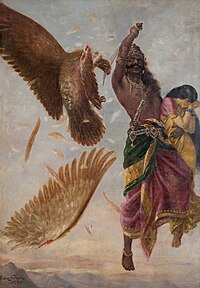
Jatayu was struck down by demon Ravana
Their eldest son, Kerala Varma, born in 1876 went missing in 1912 and was never heard of again. Their second son was Rama Varma (b.1879), an artist who studied at the JJ School of Arts, Mumbai, married to Srimathi Gowri Kunjamma, sister of Dewan PGN Unnithan.
Raja Ravi Varma's elder daughter, Ayilyam Nal Mahaprabha Thampuran, appears in two of his prominent paintings and was mother of Maharani Sethu Lakshmi Bayi of Travancore. He had another daughter, Thiruvadira Nal
Kochukunji Thampuran, grandmother of Chithira Thirunal Balarama Varma Maharajah. His third daughter, born in 1882, was Ayilyam Nal Cheria Kochamma Thampuran.
His descendants comprise the Mavelikara Royal house while two of his granddaughters, including the said Sethu Lakshmi Bayi, were adopted to the Travancore Royal Family, the cousin family of the Mavelikara House, to which lineage the present Travancore Maharaja Uthradom Thirunal Marthanda Varma belongs. Well known among his descendants are writer Shreekumar Varma (Prince Punardam Thirunal), artists Rukmini Varma (Princess Bharani Thirunal) and Jay Varma, classical musician Aswathi Thirunal Rama Varma and others.
Radha Madavam
The Maharashtrian Lady
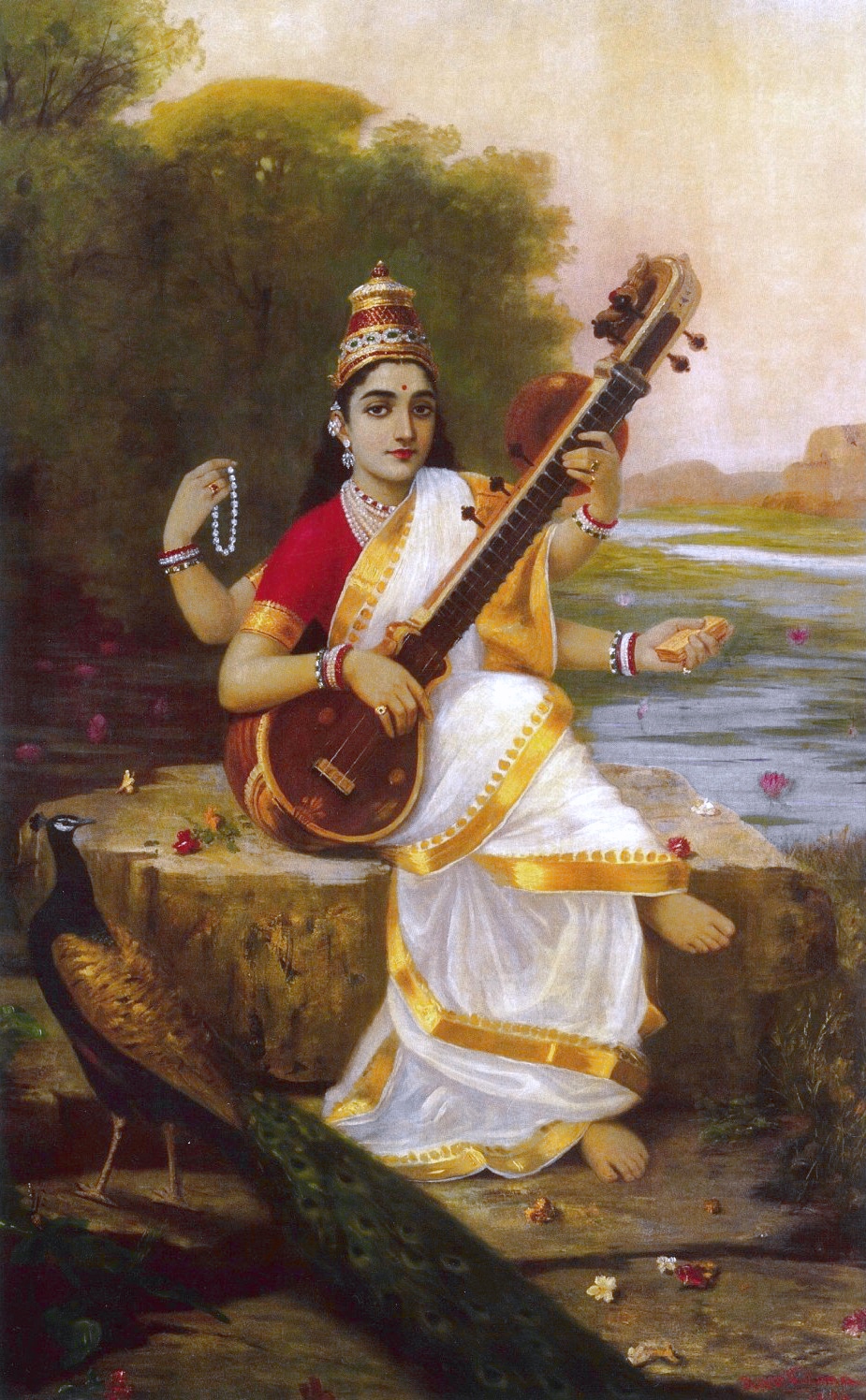
Saraswathi
he Lady in the picture is Mahaprabha Thampuratti
of Mavelikara, the artist's daughter and mother
Asal Usul Nama Tempat di Negeri Johor
Asal Usul Nama Tempat
Wujudnya nama sesuatu tempat bergantung kepada beberapa sebab. Adan yang berpunca daripada kepercayaan atau cerita-cerita lisan (Kampung Batu Badak). Ada yang berasal daripada alam semulajadi seperti keadaan sekitar (Kukup), haiwan (Rengit) atau tumbuh-tumbuhan (Gunung Pulai) dan ada mengambil sempena nama tokoh-tokoh tempatan (Tenang). Sesetengah nama tempat pula lahir daripada peristiwa yang berlaku di tempat itu (Gelang Patah). Suatu hal yang menarik ialah perubahan yang berlaku kepada sebutan nama sesuatu tempat itu. Ada kalanya ia merupakan singkatan kata, pengubahan bunyi atau kepilatan sebutan. Jadi mari kita meneliti nama-nama tempat yang popular dinegeri Johor seperti dibawah.Terdapat juga nama-nama yang tak dapat dihuraikan kerana tidak dapat mengenalpasti asal usulnya.Batu Pahat
Nama Batu Pahat dikatakan dari peristiwa memahat batu untuk mendapat bekalan air tawar di pantai Minyak Beku yang terletak di Kuala Sungai Batu, Batu Pahat. Kerja ini dilakukan oleh angkatan tentera Siam (Orang-orang Muslim Pattani Siam ) di bawah pimpinan Awi Dicu dalam abad ke-15 sewaktu hendak menyerang Melaka. Kesan pahatan tersebut masih terdapat hingga sekarang. Kesan ini dikenali sebagai Perigi Siam atau Perigi Batu Pahat. Pusat bandar bagi daerah Batu Pahat ialah Bandar Penggaram. Nama Penggaram itu dikatakan berasal daripada ‘pangkal jeram’, kerana terdapat jeram di sebuah sungai kecil yang mengalir dari bukit belakang bandar tersebut.Muar
Muar lahir daripada perkataan ‘muara’ iaitu kuala sungai. Ini disebabkan oleh penempatan awal di kawasan tersebut terletak di muara Sungai Muar. Sungai Muar terkenal sejak zaman silam kerana sungainya yang lebar membolehkan para pelayar berlindung di musim gelora. Pelarian Raja Iskandar Syah (Parameswara) dari Singapura setelah dialahkan Majapahit pada awal abad ke-15 menggunakan sungai ini. Demikian pula apabila Melaka jatuh ke tangan Portugis pada tahun 1511, raja dan para pembesar Melaka melarikan diri melalui Sungai Muar.Versi lain mengenai kewujudan nama tersebut ialah daripada perkataan ‘muak’ (jemu dan ‘mu-aru’ (Bahasa Tamil) bermaksud tiga sungai.
Bandar Maharani yang menjadi pusat bandar utama daerah Muar mendapat nama sempena nama Permaisuri Maharaja Abu Bakar pada 12 Ogos 1887. Oleh kerana pada masa itu Sultan Abu Bakar masih memakai gelaran Maharaja, permaisuri baginda memakai gelaran Maharani. Bandar itu dinamakan atas nama permaisuri yang megiringi Baginda dalam upacara perasmian bandar itu, Maharani Fatimah.
Sunday, September 04, 2011
Kalau Nak Bercerai Tangguh Dulu !

Jika anda sudah berkahwin tentu tahu yang bertengkar itu lumrah suami isteri. Kalau tak pernah bertengkar, sepanjang tempoh bersama memang pelik.
Sepasang suami isteri yang sudah berkahwin selama 7 tahun dan memiliki 3 orang anak, berselisih faham dan bertengkar hebat. Punya hebat bergaduh sampai akhirnya mereka putuskan untuk bercerai, mengakhiri kehidupan rumah tangga mereka secepat mungkin.
Mereka menemui seorang peguam, untuk berunding hal pembahagian harta sepencarian di antara mereka, perundingan berlangsung lancar dan akhirnya sebagian besar masalah dapat diselesaikan, baik tanah, rumah, dan semua aset harta mereka dapat dibahagi dan mencapai kepuasan kedua belah pihak. Hanya satu hal tidak ditemukan jalan keluarnya, yaitu mengenai pembahagian anak mereka yang 3 orang.
Baik si suami maupun si isteri, masing-masing nak jaga 2 anak, tidak ada yang mau mengalah. Tidak ada jalan penyelesaian. Akhirnya mereka menemui seorang Tua yang warak, meminta nasihat bagaimana jalan keluar yang harus ditempuh.
Saturday, September 03, 2011
Gurudev Shivananda
spiritual teacher and a proponent of Yoga and Vedanta. Sivananda was born Kuppuswami in Pattamadai, in the Tirunelveli district of Tamil Nadu. He studied medicine and served in Malaya as a physician for several years before taking up monasticism. He lived most of the later part of his life near Muni Ki Reti, Rishikesh.
He is the founder of The Divine Life Society (1936), Yoga-Vedanta Forest Academy (1948) and author of over 200 books on yoga, vedanta and a variety of other subjects. He established Sivananda Ashram, the location of the headquarters of The Divine Life Society (DLS), on the bank of the Ganges at Shivanandanagar, at a distance of 3 kilometres from Rishikesh.
Sivananda Yoga, the yoga form propagated by him, are now spread in many parts of the world through Sivananda Yoga Vedanta Centres, but these centres are not affiliated with Swami Sivananda's original ashrams which are run by the Divine Life Society.
Saraswati Maa our self essence
Goddess Saraswati is the Hindu Goddess of Learning, Knowledge and Wisdom. The Sanskrit word ‘Sara’ means ‘essence’ and ‘Swa’ means ‘self’, thus Saraswathi means “the essence of the self”. Goddess Saraswati is represented in Hindu mythology as the “Mother of all Vedas” and the consort of Lord Brahma - the creator of the Universe. Since knowledge is necessary for creation, Saraswati symbolizes the creative power of God Brahma. The goddess is also called ‘Vak Devi’, the Goddess of Speech.
Appearance of Goddess SaraswatiGoddess Saraswati is usually symbolized in white sari she adorns reflects her essential purity. In her popular images and pictures, Goddess Sarasvati is depicted with four arms wearing a white saree and seated on a white lotus. Her four arms represent the four aspects of human personality in learning which are mind, intellect, alertness and ego. It is also believed that these four arms represent four Vedas which is the primary sacred books of Hindus. The Vedas represent poetry, prose and music which are the three main forms of literature. The book in one hand represents the prose which is the divine true knowledge and also her perfection of the sciences and scriptures. A rosary or a garland of crystals on the other hand represents poetry which is the power of meditation and spirituality. Bihar, West Bengal and Orissa considers Godess Saraswathy to be the daughter of Durga along with her sister Goddess Lakshmi and her brothers Lord Ganesha and Karthikeya. Rig Veda explains Saraswati as a river and in the post Vedic age she was increasingly associated with literature, arts and music. In Skanda Purana, she is the daughter of Lord Shiva.nine days Navaratri Festival. The festival celebrates the power of the feminine aspect of divinity or Goddess Shakti. The last three days are dedicated to the worship of Goddess Saraswati. On the ninth day of the Navratri festival which is called Mahanavami day, books and all musical instruments are kept in front of the goddess early at dawn and worshipped with special prayers. It is believed that the goddess herself is blessing the books and the instruments and so no studies or any other performances are carried out on that day.
Special pujas are done on the tenth day of Navaratri Festival which is called the Vijayadashami day before taking the books and the musical instruments. It is customary to start the study in fresh way which is called Vidyarambham. This is the reason why when a person’s foot accidentally touches a book or any written material or another person’s leg, an apology in the form of the person touching the object with the finger tips and then the forehead or chest.
Goddess Saraswati Devi is also seen playing a musical instrument called Veena in her front hands which represents her perfection of all arts and sciences. The pot of sacred water represents creative and purification powers. A hamsa or swan is often seen near her feet. It is offered a mixture of milk and water to symbolize the discrimination between the good and the bad. This is why she is also called ‘Hamsavahini’. In some images a peacock is shown beside the goddess representing the arrogance and pride over its beauty.
Saraswati Jayanti
Saraswati Jayanti is the birthday of Goddess Saraswati. The festival is celebrated as Vasant Panchami every year on the 5th day of the bright fortnight of the lunar month of Magha month (January - February) with great glory in goddess temples, educational institutions, and houses.
Mythology
The eastern states of Bihar, West Bengal and Orissa considers Godess Saraswathy to be the daughter of Durga along with her sister Goddess Lakshmi and her brothers Lord Ganesha and Karthikeya. Rig Veda explains Saraswati as a river and in the post Vedic age she was increasingly associated with literature, arts and music. In Skanda Purana, she is the daughter of Lord Shiva.
How Goddess Saraswati is worshipped
Saraswati Puja is conducted during the nine days Navaratri Festival. The festival celebrates the power of the feminine aspect of divinity or Goddess Shakti. The last three days are dedicated to the worship of Goddess Saraswati. On the ninth day of the Navratri festival which is called Mahanavami day, books and all musical instruments are kept in front of the goddess early at dawn and worshipped with special prayers. It is believed that the goddess herself is blessing the books and the instruments and so no studies or any other performances are carried out on that day.
Special pujas are done on the tenth day of Navaratri Festival which is called the Vijayadashami day before taking the books and the musical instruments. It is customary to start the study in fresh way which is called Vidyarambham. This is the reason why when a person’s foot accidentally touches a book or any written material or another person’s leg, an apology in the form of the person touching the object with the finger tips and then the forehead or chest.

5 Perkara Yang Anda Rasa Betul, Tetapi.. sebenarnya SALAH!
1. Anak anda mendapat kecederaan di kepala hingga tidak sedarkan diri.
Tindakan awal anda mungkin membawa mangsa tersebut balik ke rumah atau mengejarkan mangsa ke hospital. SALAH! Mengikut pakar, tindakan bijak yang perlu dilakukan ialah menghubungi 999 untuk bantuan kecemasan.
Ini kerana dengan kecederaan kepala, anda tidak tahu betapa seriusnya kecederaan yang dialami. Mangsa mungkin turut mengalami kecederaan otak atau tulang belakang, dengan mengubah kedudukan mangsa mengakibatkan keadaan bertambah buruk.
Apa yang perlu anda lakukan ialah memastikan mangsa masih bernafas dan mempunyai nadi. Jika jawapannya ya, anda boleh menepuk mangsa sedikit dan memanggil namanya untuk melihat samada kanak-kanak itu masih sedar. Jika mangsa tidak bernafas mulakan CPR dengan segera.
2. Anak anda hilang di tempat awam.
Tindakan awal anda mungkin mencarinya sendiri. SALAH! Dalam keadaan dunia sekarang, kita harus mengandaikan yang terburuk. Mencari seorang diri di tempat yang luas dan besar akan mengambil masa yang panjang. Tindakan yang sewajarnya ialah meneliti di kawasan sekeliling anda dan menjerit memanggil namanya.
Jika itu tidak berhasil, minta pertolongan dan bantuan daripada kakitangan di tempat tersebut dengan segera. Pekerja dan kakitangan gedung-gedung yang besar selalunya telah dilatih untuk mengatasi situasi sebegini. Mereka boleh memantau laluan keluar masuk, memeriksa tandas-tandas dan sebagainya. Jika tindakan itu gagal untuk menemui anak anda, hubungi polis dengan segera.
3. Anda melihat anak kecil anda memegang botol ubat atau bahan keperluan rumah yang merbahaya dan anda tidak tahu samada ia telah menelannya.
Tindakan awal anda mungkin menyimpan bahan tersebut dan memerhati keadaannya samada jika dia mula jatuh sakit. SALAH! Pakar-pakar mengesyorkan supaya anda tidak tunggu dan lihat apa yang akan berlaku.
Sebaliknya, bawa anak anda untuk menjalani pemeriksaan atau hubungi bantuan kecemasan dengan segera. Mereka boleh memberi nasihat samada bahan tersebut tidak beracun atau pun membawa anak anda ke bilik kecemasan.
4. Anda dapat lihat tubuh anak anda di dasar kolam renang.
Jika keadaan ini berlaku apa yang terlintas pada fikiran setiap ibu bapa ialah terjun dan selamatkan. SALAH! Mengikut kata pakar kebanyakkan orang tidak mampu untuk melakukannya bersendirian.
Tindakan yang sewajarnya; jika boleh, ialah dengan memberitahu orang lain apa yang terjadi dan meminta mereka menghubungi bantuan dengan secepat mungkin. Kemudian, sebelum anda terjun cari sesuatu untuk mengapungkan tubuh anda.
Sejurus keluar dari air, cuba hidupkan semula jantung dan paru-parunya dengan melakukan CPR. Teruskan CPR samada sehingga bantuan tiba, anak itu kembali pulih atau sehingga anda sudah tidak terdaya lagi.
5. Semasa perkelahan di tepi pantai, anak anda telah terkena senggatan ubur-ubur (jellyfish).
Tindakan awal anda mungkin membasuh tempat senggatan tersebut dengan air bersih atau sebarang bahan alkohol atau bagi sesetengah orang menyiramnya dengan air kencing. SALAH!
Tindakan yang sepatutnya anda lakukan menurut pakar perubatan ialah, membilas tempat senggatan itu dengan air laut. Air tawar atau air yang anda rasakan bersih sebenarnya akan menambahkan kesakitan.
Seterusnya buang semua sesunggut binatang berkenaan yang boleh anda nampak. Tekap tempat berkenaan dengan cuka putih (white vinegar) sehingga kesakitannya hilang. Jika keadaan bertambah buruk kejarkan ke hospital.
Mungkin tip-tip ini dapat memberi kesedaran and pengatahuan kepada kita semua.
Boozz in noon
Researchers have found that sleeping for an hour in the afternoon boosts brain power and dramatically increases its ability to learn new facts and tasks.
On the other hand, the more hours we spend awake, the more sluggish our minds become and the less able to absorb new information.
"Sleep not only rights the wrong of prolonged wakefulness but, at a neurocognitive level, it moves you beyond where you were before you took a nap," said Professor Matthew Walker, who led the study at the University of California.
Speaking at the American Association for the Advancement of Science (AAAS), Prof Walker said the results support previous research that found “pulling an all-nighter” – or cramming for exams reduced ability to learn new facts by 40 per cent.
The reason was due to a shutdown of parts of the brain regions due to sleep deprivation and the filling up of the short term memory that was usually filed and emptied during periods of sleep.
Scientists have long suspected that there is a link between sleep and memory and have suggested that it acts like a sort of filing system, enabling the brain to distinguish between important and useless information.
In the latest study, 39 healthy young adults were divided into two groups – nap and no-nap.
At noon, all the participants were subjected to a rigorous learning task intended to tax the hippocampus, a region of the brain where fact-based memories are first stored.
Both groups performed at comparable levels.
At 2 pm, the nap group took a 90-minute siesta while the no-nap group stayed awake. Later that day, at 6 pm, participants performed a new round of learning exercises.
Those who remained awake throughout the day became worse at learning. In contrast, those who napped did markedly better and actually improved in their capacity to learn.
These findings reinforce the researchers' hypothesis that sleep is needed to clear the brain's short-term memory storage and make room for new information, said Prof Walker.
Prof Walker said that fact-based memories are temporarily stored in the hippocampus before being sent to the brain's prefrontal cortex, the filing cabinet of the mind.
"It's as though the e-mail inbox in your hippocampus is full and, until you sleep and clear out those fact e-mails, you're not going to receive any more mail,” said Prof Walker.
“It's just going to bounce until you sleep and move it into another folder.”
In the latest study, Prof Walker and his team have broken new ground in discovering that this memory- refreshing process occurs when nappers are engaged in a specific stage of sleep.
Electroencephalogram tests, which measure electrical activity in the brain, indicated that this refreshing of memory capacity is related to Stage 2 non-Rapid Eye Movement (REM) sleep, which takes place between deep sleep (non-REM) and the dream state known simply as REM.
Previously, the purpose of this stage was unclear, but the new results offer evidence as to why humans spend at least half their sleeping hours in Stage 2, non-REM, Prof Walker said.
"I can't imagine Mother Nature would have us spend 50 percent of the night going from one sleep stage to another for no reason," Prof Walker said. "Sleep is sophisticated. It acts locally to give us what we need."
Prof Walker and his team will go on to investigate whether the reduction of sleep experienced by people as they get older is related to the documented decrease in our ability to learn as we age.
Finding that link may be helpful in understanding such neurodegenerative conditions as Alzheimer's disease, Prof Walker said.
Sleep is the best thing on all leaving thing and a wonderfull creation of all mighty.
Subscribe to:
Posts (Atom)